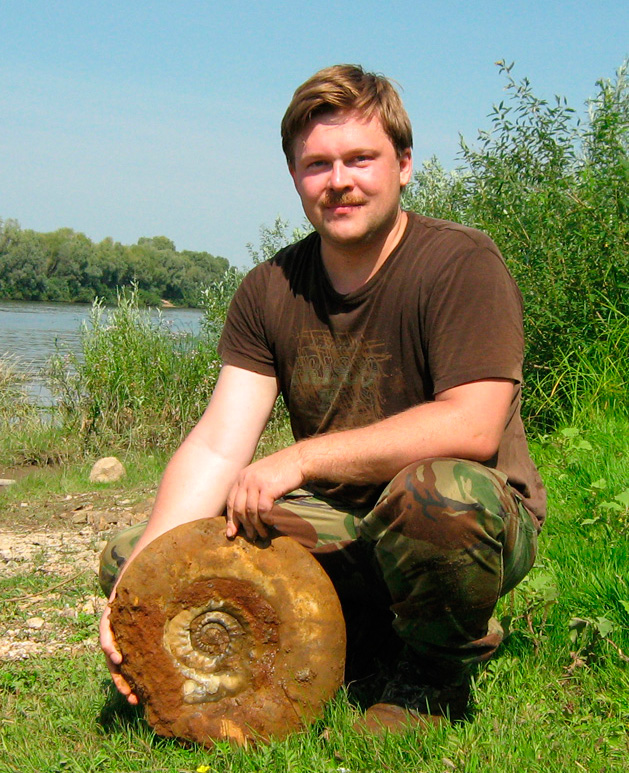
My name is Aleksandr Mironenko, I am a paleontologist and paleobiologist, PhD in Biological Sciences. I have been interested in nature and fossils since my childhood. Although for most kids the dinosaurs are the most popular ancient creatures, I always have been more interested in invertebrate fossils such as fossilized seashells. The first fossil seashells for my collection (they were Devonian brachiopods) I found in gravel on the roads of Moscow, my hometown, when I was about 10 years old.
Nevertheless, my way to the paleontological science was long and winding and for a long time paleontology was only my hobby. I graduated from university in 2003 with a BA and specialist degree (analogue of a masters degree in the old Russian system) in environmental sciences. In the first year in the university, the training included a short course of geology with elements of paleontology and with excursions to various fossil localities. After I found out where well-preserved fossils can be collected, I became an active fossil collector and amateur paleontologist. A large number of easily accessible localities of the Jurassic age in the vicinity of Moscow and in the city itself influenced the choice of my main object of collecting and later of my research - ammonites. A few years later, while still an amateur paleontologist, I completed a bachelor's degree in computer sciences. For several years I worked as a web-programmer and in my spare time made two paleontological web-sites: Paleometro.ru, dedicated to fossils which are located in the wall decorating material of the stations of Moscow Metro, and Ammonit.ru – mix of a forum, social network and a fossil record database for amateurs and specialists in the paleontology.
Collecting ammonites and fossil nautiloids led me to reading paleontological literature - I tried to read all the articles and books on cephalopod paleobiology (especially on ammonoid paleobiology) which I could find. Thanks to the Internet and help of my friends - professional paleontologists, I had access to both classic books and modern journal articles and gradually realized that among ammonites in my collection there are some paleobiological features that had not been described in literature. Since 2014 I began to describe these findings in my own publications. Thus I went from being a reader to a writer of scientific articles and became a self-educated paleontologist.
Currently, I work at the Geological Institute of the Russian Academy of Sciences (ginras.ru) as a senior researcher. My professional interests concentrate mainly on Jurassic and Cretaceous ammonoids, but cover all fossil cephalopods, including various Paleozoic nautiloids. I am interested in various aspects of the evolution, paleoecology, and paleobiology of the fossil nautiloids and ammonoids: the structure and evolution of their jaw apparatus, muscular system, and siphuncle tissues, their growth, reproduction, sexual dimorphism, etc. I like to go and take part in excavations and to find cephalopod shells for future research. I alternate between the writing of scientific papers and popular publications and maintains my websites.

Ichnofossils are fossilized traces of the biological activity of ancient organisms, which often shed light on the paleoecological interactions of extinct animals. Mesozoic ammonites are no exception: holes in the walls of their body chambers, attributed to the ichnospecies Bicrescomanducator rolli Donovan et al., indicate predator attacks that were lethal for the ammonites. In this paper we describe numerous findings of B. rolli (also known as ventral bite marks) on ammonite shells from the Middle and Upper Jurassic of European part of Russia. These findings demonstrate that the pressure of predators, which left ventral bite marks on the ammonite shells, gradually increased and reached a maximum at the end of the Jurassic. These predators were most likely various coleoids, including the ancestors of modern squids and octopuses. Not only B. rolli but other rare ichnofossils were found on the Jurassic ammonites: Oichnus ovalis Bromley and Podichnus centrifugalis Bromley et Surlyk.
More >>>
Among various drill holes located in ancient shells, the ichnospecies Oichnus ovalis is particularly important for understanding the presence and behaviour of cephalopods. In modern seas, incirrate octopuses of the superfamily Octopodoidea produce small, oval drill holes ascribed to O. ovalis in the shells of various molluscs and crustaceans. Until now, fossil O. ovalis has been primarily known mostly from the Pliocene and Pleistocene, whereas the oldest examples have been reported from the Late Cretaceous (Campanian). Here, we describe the first Jurassic record of O. ovalis, found in the ammonite Quenstedtoceras lamberti from the Middle Jurassic (latest Callovian) of Russia. The oval drill hole measuring 1.0 to 0.5 mm is located on the ammonite body chamber in the area of attachment of retractor muscles, which suggests this hole most likely was made by a predator that attacked a living ammonite in the water column. If this drill hole had been found in the Late Cretaceous or Cenozoic, it would have been attributed to an octopodoid predator. However, body fossils of octopodoids are still unknown from the Jurassic. Nevertheless, judging by some molecular clock data, incirrate octopuses might have already existed in the Late Jurassic and probably even earlier. Therefore, the Jurassic O. ovalis may have been drilled by one of the oldest octopodoids, their ancestors, or an unknown predator. Regardless of the identity of the predator, this finding expands our knowledge on the Middle Jurassic predators of ammonoids and suggests drilling on active pelagic prey arose during the Jurassic phase of the Mesozoic Marine Revolution.
More >>>
New encrusting foraminifera Tolypammina kalugensis sp. nov. is described from the Carboniferous of Central Russia. The test of the new species is large and completely attached to hard substrate, consisting of an ovoidshaped proloculus followed by an undivided tubular second chamber. The encrusting fauna is primarily composed of a monospecific association of T. kalugensis sp. nov. Additionally, there are only a few occurrences of small, phosphatic encrusting brachiopods. The remarkably low diversity and nearly monospecific encrusting fauna found in the Dashkovka Member of the Gurovo Formation indicate unusual environmental conditions. The scarcity of benthic organisms could be attributed to oxygen deficiency. Furthermore, these black and green clays of the Dashkovka Member likely accumulated in the deepest parts of the basin, situated below the photic zone, which further supports the hypothesis of oxygen-poor conditions.
More >>>
To date, soft-tissue remains of extinct incirrate octopods have been described exclusively from Upper Cretaceous deposits. Here, three specimens of an incirrate octopodid with well-preserved soft tissue imprints are described for the frst time from Paleogene strata. This material originates from the upper Ypresian (lower Eocene) fsh-bearing levels of the Bolca Konservat-Lagerstätte in the Pesciara of Bolca in north-eastern Italy. Previously, these specimens had tentatively been interpreted as teuthids. Based on a detailed study of their anatomical structure, a new genus and species of octopodid, Bolcaoctopus pesciaraensis, belonging to the extant family Octopodidae, are here erected. Bolcaoctopus gen. nov. may be distinguished from the Late Cretaceous genus Styletoctopus by the presence of long and thin arms and an elongated body shape with a narrowed apical end and covered by longitudinal wrinkles. Although fnds of fossil octopuses in the Bolca Konservat-Lagerstätte remain extremely rare, it is worth noting that Cenozoic marine vertebrate localities constitute an important potential source of additional fnds of coleoid cephalopods, the study of which may shed light on a poorly understood period in the evolutionary history of these molluscs.
More >>>
Bioclaustrations are among the best ways that parasitic associations are preserved. A new bioclaustration, Haplorygma productidophilia csp. nov., is here described from the ventral interior of the Carboniferous productid brachiopod Eomarginifera lobata. The location and morphology of the structures in the ventral valve differ from the structure in the dorsal valve, suggesting that two different organisms infested the shells of Eomarginifera lobata. It is possible that whether it was ventral or dorsal valve was an important selection criterion for the infesting organisms, which were likely parasites. The proportion of infested productids was low in the population (5.8%). This low infestation rate could indicate that productids had effective methods for resisting parasites, or that the parasites were ineffective in spreading through the brachiopod population.
More >>>